This is a 3-minute video featuring the early morning tuna auction at the Tsukiji fish market. Filmed and edited on only my iPhone using iMovie. Maybe I shouldn’t have been so resistant to owning an iPhone before.
Category: Travel
Post-Japan Thoughts
This has definitely been a one of superlatives. I flew on the world’s best airline, in the world’s largest commercial airplane, to see the world’s largest fish market and the world’s busiest Starbucks, to eat the world’s best sushi, visit the home of the world’s most viewed YouTube video, and visited the world’s most militarized border. I also rode on the world’s 3rd fastest train and saw the world’s 3rd tallest flag pole.
This list should make even Donald Trump proud.
Travel Journal: Nairobi
Jambo from Kenya! After a series of three arduous flights — 6, 7, and 8 hours each — we finally arrived in the capital city of Nairobi (aka birthplace of Obama). A quick cab ride later we arrived at the charming (“charming”) Hotel Embassy, where we ate a freshly prepared hot meal of beef stew and chapati which did hit the spot. Our room, on the other hand, did not. Three beds, two mosquito nets. Do the math and that’s a recipe for malaria. We were then woken up in the middle of the night by obnoxiously loud street people who sounded like they were standing outside our window. Luckily we were there for less than 12 hours total. More importantly, our safari would start the next day.

My Nemesis
Yup, Kenya has squat toilets. And I’ll be honest…these are no friend to Amir. They smell, they’re dirty, and let’s be honest, peoples…my scrawny legs aren’t nearly strong enough to support me. Luckily, this may provide the only exercise I get on the entire trip.

Travel Journal: Safari
We were picked up bright and early for our safari, but little did we know that to get from Nairobi to the Masai Mara it would be a 6-hour drive. A painful one that would involve a road so unbearably rocky that it caused several other vans to break down and our backs to require chiropractors. We were thrown around like rag dolls endlessly but finally arrived at Masai Mara national park, a 16000 square kilometer game reserve with all the wildlife you can imagine. It was a scenic and very expansive area with animals roaming freely in large packs (incidentally, a group of giraffes is known as a “grumble” of giraffes).
We spent all our days in this remarkably rugged van with a removable roof that allowed us to stand up for better views:

Some of my favorite animals: giraffe, zebra, and warthog.

We were treated to a beautiful sunset our first night in the Masai Mara:

Big 5
Every visitor embarking on an African safari hopes to catch sight of the “Big 5″ animals: the water buffalo, elephant, rhino, leopard, and lion. We lucked out and saw all almost immediately. Water buffalos and elephants were monstrous and potentially deadly beasts, yet slow moving and gentle. The rhino was massive but unfortunately a bit too far away from us to appreciate fully. The lions and leopards were truly beautiful and majestic animals, and it was breathtaking to see them roaming around in their natural habitat.

We lucked out and also witnessed the Obese 3:

Wildebeest Migration
Wildebeest are unattractive cow-like animals that migrate in a group of over one million in pursuit of food. The migration lasts nine months, tours much of Kenya, and finally ends up in Masai Mara in September, hence the motivation for our safari trip at this location at this time.
We came across them as they encountered the Mara river…the hippo and crocodile infested Mara river. The wildebeest stood there for hours like idiots debating whether to cross (“you go first, no you go, no you go”)…and like bigger idiots we parked our van there and waited forever for them to cross. Thankfully they finally made up their mind and crossed the river. Fortunately for them, none were attacked. Unfortunately for us, none were attacked.

Leonard
I cannot describe our safari without mentioning our driver and guide, Leonard. A curious guy he was. On the one hand he was incredibly knowledgeable based on his 16 years of experience. He was also a skilled driver who knew exactly where to drive us to get the best views of the more difficult-to-find animals; while other drivers would crowd around a lion walking, Leonard would aggressively race ahead off-road and deliver us to an empty area, only to have the lion stroll over a few minutes later where we had him all to ourselves.
But socially, Leonard was something special. Perhaps that same 16 years of experience made him lose enthusiasm, but he had little interest in talking to us. Rarely would a “good morning” or “bye” come from his mouth, and also we had to ask him any question three times before he’d even consider looking at us. And when he did it would either be with angry and irrelevant responses (us: “why do wildebeests form those groups?”, Leonard: “THERE ARE 40-50 WILDEBEEST IN A GROUP, OK?!”) … or with the least detail possible (us: “why are the wildebeest taking so long to decide to cross the river?”, Leonard: “animals”) … to exquisite detail (us: “what is an elephant?”, Leonard: “elephants roam the Masai Mara, which is 16485.3 sq km, and they live 50-80 years and have a gestation period of 2 years”).
Here is Leonard being Leonard…avoiding us. While talking on his tablet/cell phone. With an annoying Black Eyed Peas ringtone:

Travel Journal: Zanzibar
Jambo again, this time from Zanzibar! Zanzibar is a small island off the coast of Tanzania surrounded by lovely turquoise waters and full of the whitest sand beaches. We couldn’t have chosen a more ideal place to stay after our safari, as our last 24 hours of Nairobi were completely devoid of sleep, hygiene, showers, and hotel rooms with lights that actually turn off. We also wasted 3 hours in a live comedy show that was supposedly in English but ended up being only in Swahili. On the bright side, my face may be on a Kenyan TV show soon. We arrived at an empty Nairobi airport at 5am for our 8am flight just to escape the loud hell that was the Hotel Embassy, but once we landed in Zanzibar and felt the warm air blow across our faces, it was all worth it.
Kendwa Rocks
We are staying on Kendwa beach at the idyllic Kendwa Rocks resort, an oasis of luxury on this until-now dirty vacation. Our room features a balcony with lounge chairs that overlooks the beach just a few hundred feet away, there is instant hot water, western style toilets, air conditioning, and wifi (however slow). There is no need to leave the resort since there’s a restaurant and bar here as well as an office that organizes any activity you want.
Here is the view from our awesome room:

The beach is even more amazing from the water:

I’d show pictures of what we do all day but it’d only be pictures of us lounging on the beach with the occasional waking up to eat a meal or take a stroll.
We went on a snorkeling trip one day and enjoyed lots of pretty tropical fish and coral, including my favorite combo of clownfish and anemone. Unfortunately the boat forgot about us and left us in the water for an extra 45 minutes. Punks.
Out of Africa
It seems we can’t leave any city on this trip without being subjected to mild torture. The ferry ride from Zanzibar to the Tanzanian capital of Dar es Salaam wasn’t pleasant either. We were hoping the extra money we paid for the “fast ferry” would provide us a smooth ride but our trip was anything but. We were subjected to two hours of super choppy waters, people vomiting left and right, and a ceiling air conditioner that dumped water on us every few minutes. And at one point I stepped outside for a breath of fresh air and realized I was standing next to this:

That’s right…a coffin. I was kicking it with a dead guy. At least his ride was probably more peaceful than mine. Rest in peace, nameless man.
Travel Journal: Safari video
This is a short 1-minute video I made featuring the highlights of our recent African safari. If I never see a wildebeest again it’ll be too soon!
Introducing Iceland (and Greenland)
Welcome back, peoples! Despite my efforts to stay local and domestic this year, I succumbed to the travel bug and booked a last-minute flight to Iceland.
Why Iceland? Mostly because I spun an e-globe (i.e. Google Maps), closed my eyes, and dropped a finger down on a random country. I don’t know much about the country — until today I didn’t even know what language they spoke (Icelandic) — but it definitely seems like a land where modern civilization meets kingdoms of previous eras, when vikings ruled the world and elves ran around freely. It’s full of natural wonders such as volcanoes, geysers, thermal baths, fjords, and more. It’s also full of interesting and long names such as Reykjavik, Kerlingarfjoll, Eyjafjallajokull, and Aflugennugenblugen. (I may have made up one of those names.)
I will be traveling once again with Rubin — a friend from medical school who I went to South America and also took a bromance trip with — and our itinerary includes flying into Reyjkavik, Iceland and spending a few days there exploring scenery, visiting castles, eating herring, and similar things. We also decided to hop over to Greenland and see what that country has to offer. As of now, all I know is that Iceland is green and Greenland is ice. Let’s see how true that is.

I’m taking a ridiculous amount of technology with me, including my iPhone, iPad, Canon Powershot camera, and GoPro video camera. Also I’ve packed an odd collection of clothes and items, including thermal underwear, scarves, and gloves (for cold weather) and swimsuit and snorkel gear (for warm weather…I hope).
That’s it for now. See you on the other side.
Travel Journal: Iceland 1
Halló from Iceland! First off, why didn’t anyone let me know it’s cold here … I’m quite under prepared for the wind and cold weather here. It doesn’t help that I forgot those thermal underwear I mentioned earlier, because my bits are freezing. It also doesn’t help that the locals love to announce “Reykjavik is so warm this time of year.”
Thermal baths
Iceland is full of volcanos and people who love to swim (Reykjavikurs went swimming an average of 15 times last year)…so what better way to combine the two than with geothermal baths. The water in these pools are warmed by volcanic flow, keeping them around 30 degrees C.
As my first activity in this country I visited Laugardalslaug, the largest pools in Iceland, including several Olympic sized ones as well as multiple “hot pots” (essentially jacuzzis, with extra hot water being pumped in.)
Icelanders are very particular about tourists being dirty and thus everyone is required to shower before entering the pools. No big deal, but then I saw this sign:

Great. Not only do they want you clean but they want your swimsuit clean too, but separately from your body. Reluctantly I stripped down and walked into the shower area while — and here’s the best part — some teenage kid on a power trip watched us all to make sure we were showering properly. I’m pretty sure that is how they do it in prison.
In any case, I actually went on to have a great swim followed by a long sit in their hot pots, kept at very toasty 42 degrees. I was so jet lagged I almost fell asleep several times. Overall, except for the fact that I paid money to shower naked with other men, it was a great experience.
Quad tour
A unique way to experience the more natural parts of Reykjavik is with a quad (or ATV as I thought they were called.) We took a quad tour at nighttime of the city and its outskirts, riding through mountains, dirt roads, and shallow rivers. These 4-wheeled beasts were much bigger than I thought, and we took them to nearly 60 mph (100 kph if you’re European.)
I was already a bit apprehensive because of all the injury horror stories I’ve heard they cause, but I ended up feeling much safer than expected.

What certainly is not safe is driving with only one hand.

By the way, these shots were all taken around 11pm at night.
Geysers
One of Iceland’s most famous attractions is Geysir, the natural hot water spout after which all others in the world are named (i.e. “geysers”). Geysir is the grand daddy of them all but unfortunately stopped erupting in the 1950s after tourists threw rocks in there and clogged him up. This is poor Geysir today:

Luckily, just down the road is Strokkur, probably the world’s most reliable geyser. She erupts consistently every 8-10 minutes and really is an exciting sight to see.

Travel Journal: Greenland
Today was … memorable. Air Iceland offers day trips from Reykjavik to Greenland, and since it’s unlikely I’ll be in the region again soon, I figured why not visit an extra country (interestingly, Greenland is not entirely independent but rather part of the Kingdom of Denmark.) Specifically we would visit Kulusuk, a small village with no flushing toilets populated by only 200 residents who are Inuits. We boarded our plane and two hours later landed in the faraway village. We were filled with excitement and hope.
We were met by our guide Johann, a Danish man with graduate school education in anthropology living part of the year in Greenland and the rest in Iceland, who led us on our hike from the airport to the village. After an hour of walking and hearing interesting history about the region, Kulusuk — with its brightly colored wood houses — became visible. A bit barren, but we were still intrigued at this point.

How quickly our minds changed. A few hours here convinced us that this small village was perhaps the most depressing community we had ever experienced. The village was essentially a ghost town, with no signs of anyone trying to make a living or wanting to have purpose. And none of the residents appeared to be interested in preserving any aspect of their culture, from their village (covered with filth) to their identity (most were unemployed due to poor work ethic) to even their own health (significant alcohol abuse and more).
It was so depressing it became comical. The only thing we could do to keep us from losing our sanity was make fun of the situation. To more accurately describe our visit there, I will now contrast what our tour itinerary promised with a more realistic itinerary … based on what we actually experienced.
—–
Your guide will escort you from the airport to the engaging village Kulusuk…
Your guide will lead you on a hike through rocky hills instead of the flatter main road (and say “but if I had Chinese people in my group I’d use the easy roads.”) You will then reach a village littered with trash and where inbreeding runs rampant.
…where you can stroll about and meet some of the 250 local residents and view their quality crafts.
You will see at most 15 local and probably drunk residents, including a man who’s lived in the village for 32 years but was so drunk he couldn’t remember half of it, and “Mrs Unfaithful”, the town prostitute who everyone — except her husband — knows is pregnant.
You’ll be treated to kayaking demonstrations and an ancient drum dance reflective of the indigenous culture.
They will drag a really old kayak out of a shed and show it to you for 5 minutes. You won’t get a drum/dance show but you will see the dance hall where performances used to be held.
On your return flight to Reykjavík you enjoy a spectacular view over huge glaciers and floating icebergs.
Your guide will charge you an extra $30 then throw you on a little boat filled with guns, going 1 mph (but, you will see icebergs!)


You will also receive a certificate of visit.
You will be treated to a day-old hot dog that you have to pay for yourself.
Lunch or refreshments are not included.
At least they got one thing right.
—–
Admittedly I’m being somewhat harsh, and I am certain Greenland has much beautiful scenery and unique activities; Kulusuk was just not the place to experience them. I would happily return to other parts of this country especially as part of a trip to the Arctic. Until then, this is one passport stamp that was quite painful to earn.

Travel Journal: Iceland 2
Three unique outdoor adventures and two unusual food adventures. Read on…
Inside the volcano
I took a journey toward the center of the earth by descending deep into a dormant volcano. The Thrihnukagigur volcano last erupted 4000 years ago and for some reason left behind a magma chamber that is completely hollowed out (they explained why but I couldn’t follow along; I barely know what magma is.)
We hiked 45 minutes in the great outdoors to reach the entrance of the volcano. There is only one way to enter the volcano and that’s through a very narrow crater at the top:

Using an elevator similar to a window washer’s elevator for high rise buildings, we descended 120m down to the floor of the volcano. It was a bit claustrophobic at times but overall ok. This cartoon puts into perspective how deep the crater (and we) go down:

Seven minutes later we reached the bottom. It was fascinating down there, with a very interesting array of colors on the rock walls, a tiny pinhole of sunlight from the crater opening far above our heads, and the enormous size of the volcanic chamber inside.


If you ever come to Iceland, do this.
Scuba diving
Scuba diving typically isn’t an activity that people — including myself — associate with Iceland. However, I discovered that not only is diving possible here, but it offers several things not found anywhere else in the world.
We went diving in the Silfra fissures, which is notable because 1) it’s in the Thingvellir National Park, which is where Game of Thrones is filmed, 2) it’s where the world’s oldest parliament was first created, and most interestingly 3) it’s where the continents of North America and Europe meet. Specifically it’s where the North American and Eurasian tectonic plates meet. (If I understand this correctly, continents are the parts of the plates that rise above the ocean; this graphic describes it better.)

As you might guess, the water temperature is close to freezing (about 3 degrees C). But this extreme cold allows for some of the clearest and most pristine waters on the planet.
Surviving such a cold water dive required a dry suit, which I had never worn before. I thought wetsuits were heavy, but that’s nothing compared to what we wore: a layer of thermal underwear (I was forced to buy some here), followed by a thick fleece undersuit (a fleece onesie), and finally the thick neoprene drysuit itself. Over all that we had extra weights (16kg!) and then the usual gear. It was nearly impossible to move. I became so hot walking around I couldn’t wait to jump in the water. But I did … and it was cold … so cold. The only semi-exposed body parts while wearing a dry suit are your wrists and your face, and I really thought they would develop frostbite.
In the end, though, it was all worth it because the views were phenomenal. There was easily >100m of visibility in that clear blue water. Although there was no marine life, there were plenty of interesting things to look at. Here I am touching both North America (right side of photo) and Europe (left).

A typical view throughout the dive.

The experience was well worth it and highly recommend it to any diver who finds themself in this part of the planet.
Hot springs
Iceland is full of volcanic activity, which means there are lots of active geothermal fields. We visited a popular one in the city of Hveragerdi, which involved a very arduous and very uphill 5km hike through endless steaming and stinky sulphur holes and green mountains as far as the eye can see.

Amazingly we did eventually make it there after two hours and were rewarded by a warm river that we relaxed in for a long time.

Hot dogs
It turns out Icelanders love hot dogs. They are cheap and you can find them everywhere. If you see a line of people in this city, chances are they’re lining up for a pylsur, or hot dog.
I hunted down Bæjarins beztu, a very simple hot dog stand that allegedly makes the best dogs in the country. There’s always a line in front of this stand waiting to get “one with everything” (a dog with ketchup, mustard, a special sauce, and fried onions.)

It’s been a long time since I’ve had a hot dog, so while I don’t have much to compare to, it really was tasty. Made of beef, pork, and lamb, it actually tasted like real meat and best of all it had a great snap when you bit into it. Bill Clinton even ate here multiple times whenever he visited.

(This is now the second place I’ve visited that Bill liked. Hopefully my heart doesn’t follow in his footsteps too.)
Fresh meat
I did something I’m not proud of tonight. I ate Iceland’s two most well-known wildlife animals: whale and puffin. Each is somewhat of a delicacy here and I figured when in Rome … why not?
 |
 |
 |
The puffin was smoked and thus not tasty at all; I dislike all things smoked. Whale meat was interesting. It was (very) red meat but had a texture and taste more like fish. It didn’t taste bad but I felt guilty eating a fellow mammal. As a friend to the fishes, I felt so guilty that I returned home and went to WWF’s website and partially alleviated my guilty by adopting a whale. (Afterwards the website asked what prompted me to donate, and presented me with a list of options like TV ad, word of mouth, etc. I looked for a “I ate one of your animals and felt bad” option but fortunately didn’t see one.)
Join me and adopt an endangered species too!
Travel Journal: Iceland 3
Back home, safe and sound. Iceland was a great country that would keep any outdoorsman busy for weeks. But beware to those who visit: Iceland is outrageously expensive. A bottle of beer cost $9, a bowl of soup was $15, and a pair of long john bottoms was $110. Hot dogs, on the other hand, are nice and cheap.
Here is a cheesy and short (2 min) movie I edited together, summarizing my activities there.
New York City 2014
Who needs international travel when there’s such an amazing city here in our own country. Work has brought me to New York City, a city that I’ve only visited a few nights total in my life, and this time I got to stay for several days. This city is so lively and so energetic, it’s hard to believe anyone would want to live elsewhere. Dare I say I may even like NY better than SF? To be determined.
I almost couldn’t contain my giddiness when I stepped out of my hotel and tried to absorb everything: crowds of people rushing by, high-rises covered with bright neon lights, streets filled with honking yellow cabs, and to top it off my fancy hotel has free internet … I love the internet! I may need a sedative.

Here are some highlights from my short trip.
BAM! More like WEIRD!
I met my aunt and we took the subway to see a show at the Brooklyn Academy of Music. This is America’s oldest performing arts center, and we had tickets to watch The Source, a performance about Bradley Manning, the Army private who leaked tons of classified military documents to the public. He was arrested in 2013 after chatting online with various people who then ended up turning him in. The show’s concept was fascinating: voices would recite the hundreds of lines of online chats, Twitter posts, and actual leaked documents, and then synchronize it to music in this multimedia opera of sorts. Again, fascinating in theory …

… but terrible in implementation! This was the worst “artistic” piece I have ever experienced. The voices were processed and sounded so synthesized and robotic that it made Stephen Hawking sound sexy. The music was more of a random collection of dissonant electronic noises. If there are any Friends fans out there, it sounded like that terrible electronic music Ross performed in front of everyone. (Except tonight was worse: at least Ross’ performance lasted only a minute.) At first I thought I wasn’t sophisticated enough to appreciate it, but then I realized I’m the normal one here … it’s the show that was an hour and a half of auditory nonsense.
(If you don’t believe me, feel free to listen to some sound samples from the show and form your own opinion. Godspeed.)
Ramen
I love me some good noodles. Outside of Japan, there’s probably no better city to find an abundance of great bowls of ramen. In preparation for this trip I looked up the best ramen shops in the city and learned of Ippudo, which appeared on multiple lists. What luck, it was only a few blocks from my hotel. I snuck out of my conference at lunchtime and ran to the restaurant, only to see that even at lunch there was a line. But after a 30 minute wait, I was soon seated in front of a bowl of karaka-men, traditional tonkatsu (pork) broth with an added kick of spice paste and fragrant garlic oil.

My first sip of broth immediately reminded of the many bowls of ramen I ate in Japan. This is what ramen is supposed to taste like. The broth was the ideal combination of salty, rich, silky, and (for lack of a better word) porky. The noodles — homemade — were perfectly cooked and thin, and were all covered by a thin layer of the oil. I slurped that broth so quickly, I wanted to order another. Unfortunately I had to return to the conference. I am here to learn, after all.
Phall of Fame
Months ago I discovered an Indian curry called phaal which is considered the world’s spiciest curry. It is typically made with at least 10 different types of chilies and peppers, and reportedly can bring down the toughest of eaters.
Soon thereafter I learned about the Brick Lane Curry House, an Indian restaurant that offers a phaal curry that they describe as “an excruciatingly hot curry, more pain and sweat than flavor. For our customers who do this on a dare, we will require you to state a verbal disclaimer not holding us liable for any physical or emotional damage after eating this curry.” And if you can finish their curry you will be rewarded with a free beer, a certificate of completion, and a spot on their “Phall of Fame.” Spicy food and recognition for eating it? Challenge accepted.

I went there, I ordered it, I gave verbal consent, they double-checked I was serious, and once it arrived I looked at it … and it smelled atrocious. This black curry had the most potent smell and a taste that was even worse. It was certainly hot, but while it wasn’t quite as spicy as the hot wing challenge I did a few months ago, its horrendous taste made this experience much more painful. Honestly, it didn’t taste like food but more like ash. Burnt cigarette ashes. Halfway through, to keep myself from gagging, I needed to keep a piece of garlic naan in front of my nose to fool my taste buds as I shoveled down the remainder of the curry.

A long 40 minutes later, I reached the bottom of the bowl. The two tables on either side of us cheered me on and when my free beer arrived I handed it over to one of them, as I couldn’t stomach the idea of insulting my stomach any more. As promised, I also received a certificate. I have never suffered so much for recognition.

I think it’s time I retire from this spicy food challenge business.
The Night of 3 Dinners
Time flew and all of a sudden my final night in NY was upon me. I had previously RSVP’ed to a work dinner at a nearby Italian restaurant, but I still hadn’t gotten my fill of NY’s unique food scene. My work dinner was at 730pm, so once the conference ended at 5pm I darted out to the streets and visited a falafel vendor I had been eyeing for days. Falafels are among my favorite foods and such stands aren’t found in San Diego, so with over two hours until dinner I wasn’t about to let it go to waste. Here’s the brief exchange I had with the falafel guy:
Me: How many falafels come in one order?
Him: How many do you want?
Me: I don’t know … 3?
Him: How about 8?
Me: OK.
A few hours later I went (with a full stomach) to the Italian restaurant, where I was let down by a duck ragu pasta dish that had sounded very promising.
Walking back to my hotel I was lamenting the fact that my last meal of the trip was a mediocre one, when I came across Totto Ramen. It was as if someone up above answered my silent food cries with my favorite food. It was nearly midnight, but I didn’t think twice about walking in to this tiny, cramped restaurant that consisted of nothing more than a single counter, and watched as they prepared bowl after bowl of their signature chicken — not pork — ramen. I looked over their menu and people, I am proud to tell you that I ordered the “spicy ramen” and not the “extra spicy ramen”. No need to be a hero tonight. (Plus, I was still sore from the previous night’s phaal.)

Overall a fantastic trip to NY, and believe it or not I actually learned a lot too!
Around the World in 30 Days
Welcome back, peoples…get ready because this trip is a big one.
First of all, fellowship is done! After eight years of taking care of many thousands of patients, doing thousands of procedures, and sleeping hundreds of nights in the hospital, I’m finally done with my medical training. And not only did I convince a hospital into hiring me, they were generous enough to give me two months of vacation before starting my new job.
Taking full advantage of this significant time off, I’m taking a page from Jules Verne’s book and going around the world – maybe not in 80 days, but 30.
Itinerary
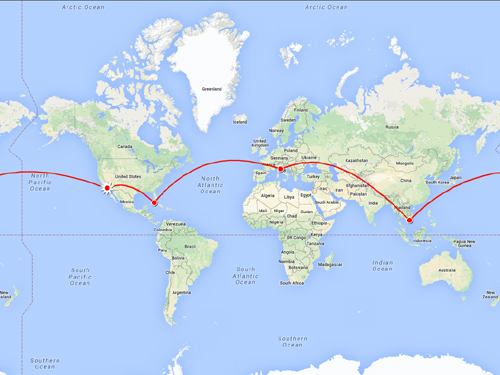
Our trip begins in Cuba. The recent relaxing of travel restrictions allows people to visit – not for tourism, however, but for education-based trips. My brother and I will thus be participating in one of these.
We then continue to Italy, where we join up with our parents to explore several beautiful cities in the Tuscany region.
Finally, they return home as I continue on to Vietnam, a country I have been eager to visit since I first visited Southeast Asia years ago.
Of course, no trip is complete without me chewing off your ears about the local food. These countries all share in common great cuisine, and I can’t wait to stuff myself with red beans and rice, as well as slow-cooked pasta and wine, and then pho and other street foods. As always, food will be a major theme of the trip.
Oh, and communism too! Cuba and Vietnam are two of the five remaining communist countries in the world (the others being China, Laos, and North Korea), while Italy is a former communist country. Perhaps I should rename this trip to “Communism: Here’s Why it Doesn’t Work”.
Finally, as I am certain many of you will (again) ask me what I pack, this should satisfy you. Yes, that’s a cardiology book.
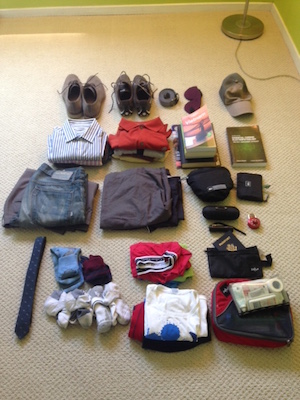
I embark upon this month-long journey tomorrow, so sit tight and see you on the other side.
Travel Journal: Miami
Happy 4th of July!
Most people celebrate 4th of July by eating apple pie and watching fireworks. I, on the other hand, chose to fly to a communist country that has minimal relations with America. After a rocky set of outbound flights — Delta adding an extra layover to my itinerary last minute, and then another flight taking off without me (I wasn’t happy about that one) — I landed in Miami to meet up with my brother. We went to the beach, only to realize we had each – independently, mind you – bought the exact same swim trunks.
We went home and never went to the beach together again.
Travel Journal: Cuba
Bienvenidos!
While our trade embargo with Cuba still remains in place, restrictions between the two countries have been eased so opportunities now exist to travel to Cuba legally. Tourism is still not permitted, but Americans can travel here via licensed educational exchange trips known as people-to-people tours. These are education-based trips that can only be offered by travel companies that have received a license from the Treasury Department’s Office of Foreign Assets Control – it’s all about the dollars. If you’re eager for more details, see 31 CFR § 515.565(b). And if you’re not down with the latest CFR §, it basically says go, but don’t deal too much with the Cuban Communist Party.
Arrival
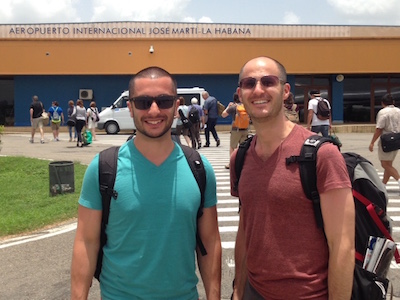
The night before departing to Cuba there was an introductory meeting where we met our group, and thankfully no one seemed too annoying. The next morning we hopped on a chartered American Airlines flight, and 45 minutes later landed in Havana. I stepped off the plane onto the runway and took in a deep breath…it smelled ripe with communism. After a very painless checkout through passport control – where the most intrusive question they asked me was “Is this your passport?” to which I replied “Si” – we were ready to explore the country. (And no, that wasn’t Rosetta Stone talking…that’s 12 years of living in Southern California. What’s up.)
Initial Thoughts
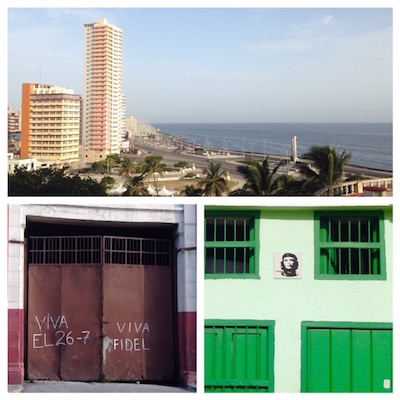
Cuba is a poor country. The impact of both governmental control and the US embargo are noticeable everywhere. Infrastructure in Havana seems developed, but it’s very outdated and dilapidated – clearly a reflection of more prosperous years past. Also, whether a result of the communist regime or simple poverty, it seems there’s almost nowhere to spend money, both for tourists or locals. There aren’t many restaurants, I haven’t seen a single grocery store or corner market, and the one furniture store I saw was empty inside. This may be the first country I’ve visited where it may not be possible to live like a local. It doesn’t help that there are two currencies in Cuba: one for locals (pesos) and one for tourists (the CUC, pronounced “kooks”, or as I like to pronounce, “Cubans”.) Local establishments – if they actually exist – will accept either, but no tourist place will accept local pesos.
Finally, God forbid you forget about Fidel Castro or Che Guevara for even five minutes…their names and faces are everywhere.
Communism
As expected under communism, the government owns most businesses and services, such as hotels, restaurants, and entertainment. The country is actively working to improve its economy by privatizing many of these companies by local and foreign investors, and it was interesting to see common items being owned or produced or run by the government: sodas, nightclubs, clothing, etc. Cuban cola was essentially free; Coca-Cola cost was expensive.
A uniquely communist practice here in Cuba is that of rationing. Every Cuban citizen is given monthly rations, and everyone takes advantage of the program. Rice, beans, toilet paper, rum…most products needed for daily life are included. Old or young, every Cuban received rations their entire life, and the only thing adults got that children didn’t was coffee. Here was a typical ration store. It was far from glamorous, but it was effective.
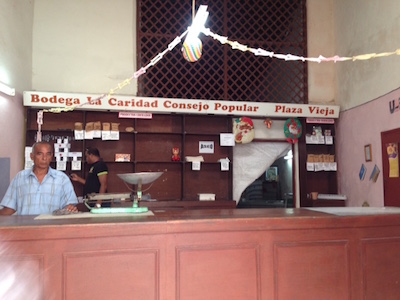
Rationing also affected us tourists in a very real way. Every day we would receive two bottles of water. And even though I toured harder than every other member of our group, I still only received two bottles. It’s tough being a communist.
Cigars
Cuba’s most well-known product and export is the cigar. Producing over 250 different kinds of cigars, Cuban cigars are considered by all to be the highest quality in the world. We had the opportunity to visit their main factory, La Corona. This factory, doesn’t produce just one brand of cigars, but all the top brands – including Cohiba, Montecristo, Romeo y Julieta, and H. Upmann.
And in what turned out to be my saddest moment of the trip, we were told there is a strict no photo policy inside the factory. Feel free to take pictures of their military, airport security, and police…but don’t dare photograph the cigar factory.
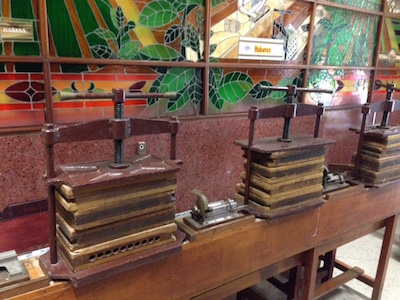
So allow me to paint a picture with words. The factory consisted of row after row of the most low-tech technology you could imagine: people sitting at small desks, pulling up one large tobacco leaf after another, and rolling it by hand. After these filler leaves were rolled together, they were put into molds on top of their desk where they were manually pressed for 30 minutes. Then a nicer, wrapper tobacco leaf was rolled around it, creating the final cigar. It was quite impressive watching a messy pile of brown leaves quickly turn into a nearly perfectly symmetric and sealed cigar before your eyes.
The cigar makers work from 7am-3pm daily, producing ~100 per day. On top of their pay they also received 5 free cigars a day. The factory prided themselves them on having a 65% female workforce, because “women are good at organization”.
Even though photos were prohibited, I managed to sneak this one of an empty part of the factory floor. The things I do for you, people…
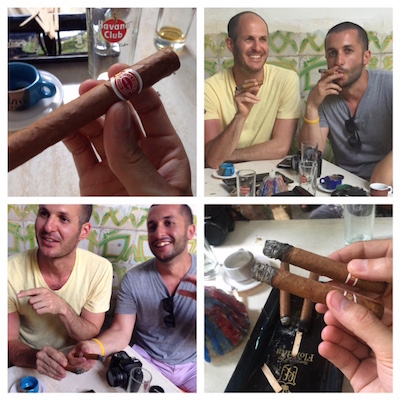
When in Cuba, do as the Cubans do. Here we are appreciating their finest. I didn’t cough (too much).
Rum
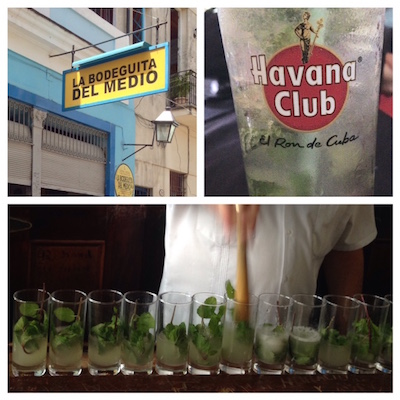
Cuba’s second famous product is rum. Most drinks contain it, and their main brand is Havana Club. And the way Morocco had mint tea and Brazil had caipirinhas, Cuba’s national drink is the mojito…a cocktail made with rum, mint, and sugar. It’s a tasty drink that goes down like water, and before you know it it’s mid-afternoon and you’ve already had 8.
Ernest Hemingway, the writer and America’s most well-known expatriate who lived in Cuba for much of his productive life, frequented the bar below for his favorite mojito in town.
Vintage Cars
To visit Cuba today is to experience a country frozen in 1950. Most notable are their cars. The roads are filled with vintage American cars, including Chevys, Buicks, and Pontiacs from the 1920s-1950s. Most are meticulously maintained and brightly colored. Even better, many were used as taxis.
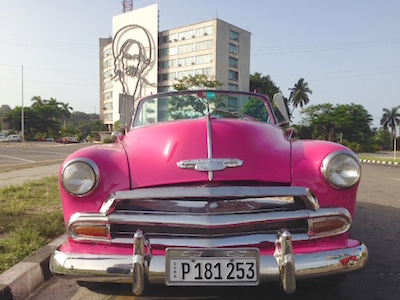
Our taxi one evening, in Revolution Plaza.
Around Havana
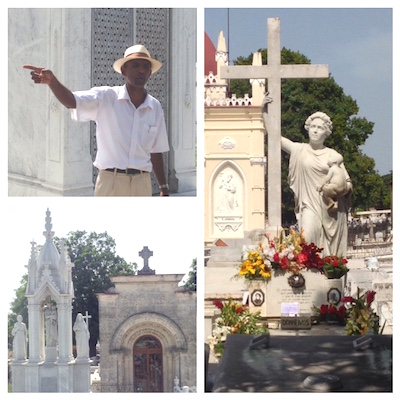
Our first day we visited the city cemetery, full of large mausoleums containing the remains of famous and ordinary Havana citizens. Cuban Barack Obama showed us around and pointed out the more popular tombs, including that of Ernest Hemingway’s bartender and Amelia, a woman whose baby survived some great catastrophe and nowadays people visit her tomb to have their wishes granted.
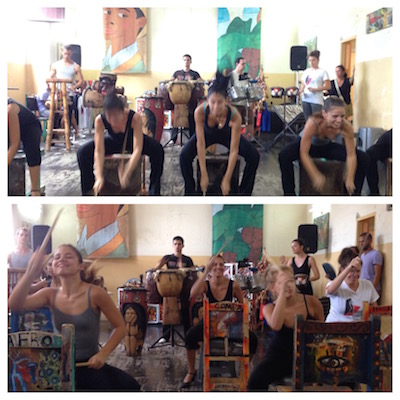
We visited a local organization that acts as a community center for underserved youth to hone their creative skills and perform community service. Cuban Macy Gray charmed everyone with her voice.

Our final day we were treated to an amazing private show by the Havana Compass dance studio, a private dance company. They made amazing — and amazingly loud! — sounds with their drums, chairs, and sticks. Think of it as Cuban Stomp…but probably better.
Earlier in the week, Cuban Morgan Freeman grabbed me on the street. I thought that was strange and then he put me in a headlock…which was even stranger. We had to give him 2 pesos before he let me go. Sadly no one got a photo of it.
Parting Thoughts
I arrived in Cuba ready to show them how great America is…they could finally learn about affordable healthcare, gay rights, and bald eagles. But after a few days there I learned that despite their terrible economy, Cubans are a remarkably upbeat and happy people. They’re kind and welcoming, and they’re also incredibly talented and passionate in all things artistic and musical (I’ve never heard so much great live music.) There’s certainly a lot we can learn from them. And who knew…they already have affordable healthcare!
As a visitor I never felt threatened roaming around town, even in the middle of the night. Cuba is one of the safest countries in the western hemisphere, and it certainly felt that way. Above all, there were essentially no beggars. Almost never was I approached by someone asking for money…very refreshing. (Hint, hint, Morocco.)
Some countries are communist but still successful, while others have US-imposed sanctions and are (moderately) successful. The combination, however, appears to be the kiss of death. Hopefully each of these aspects will be rectified in the near future and create better opportunities for the Cuban people to prosper.
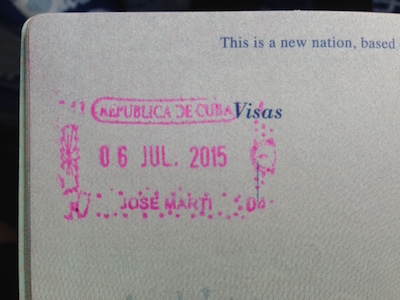
(By the way, because of this passport stamp, any time I re-enter the US in the future I need to show paperwork proving this visit to Cuba was in fact legal.)
Baseline Wander | Design by YoArts.